
My Father
Víctor Silva
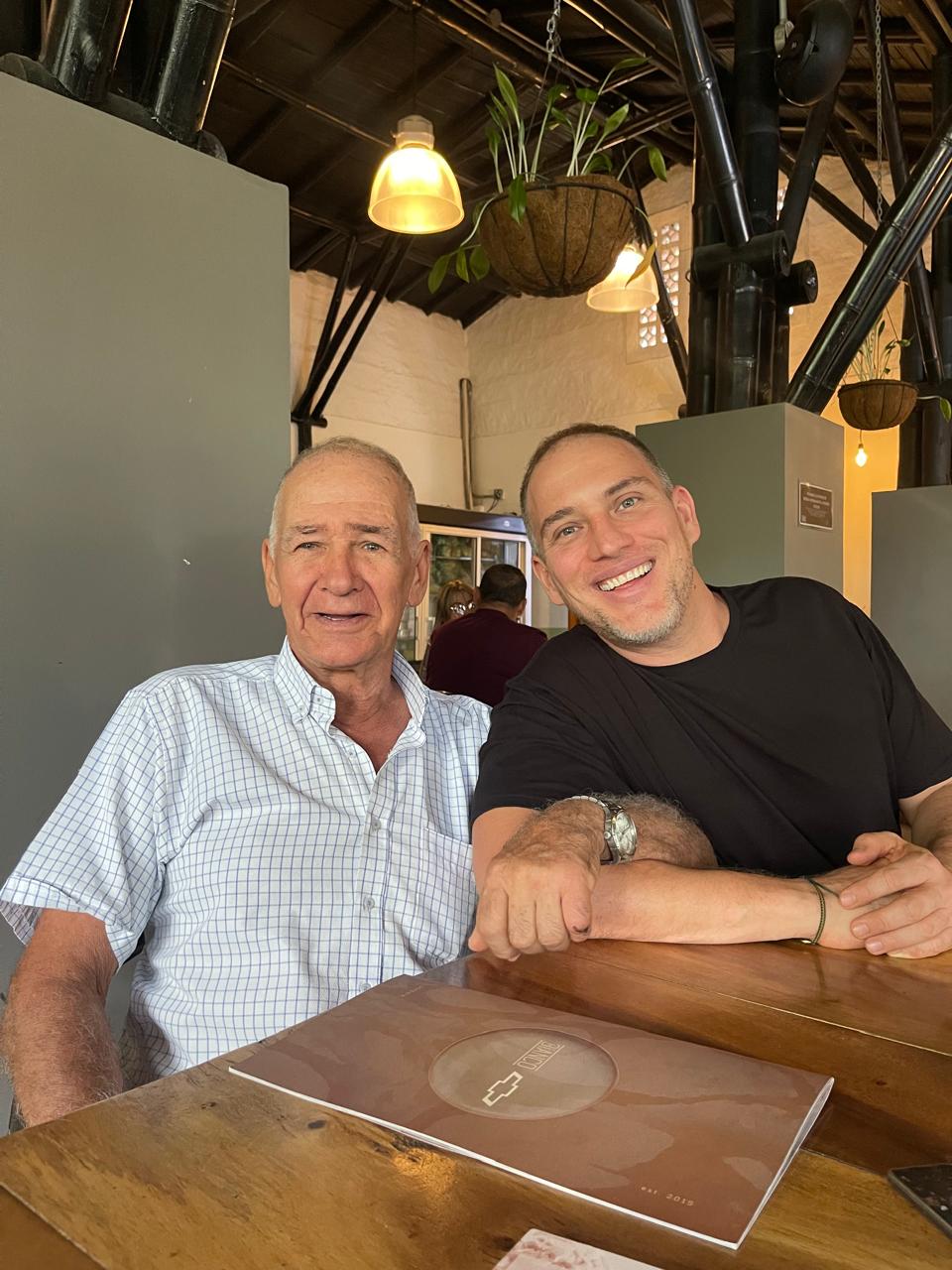
My father died.
On Sunday, at eight in the morning, I received a message from my brother with the news. I skimmed it, still focused on what I was doing, and carried on with my things. I allowed myself to feel the sadness it brought, and went to wake Marce; as I told her, I cried a little with her. Beside her I have learned to share those things I preferred to keep to myself for much of my life, to feel and express myself in someone else's company.
A few days have passed, and here I am, trying to write about him. Sometimes, as I remember, tears come, something that does not happen to me very often, and then I can go on with my day. The truth is, I do not quite know what I feel. Or perhaps I do, but I do not need to feel it in any particular way. My father died, and that makes me sad; the sadness appears, stays with me for a while and then leaves, without taking up everything. Most of the time I feel more thoughtful than anything else.
I have spent days piecing together memories, conversations and things that happened that I thought I had forgotten. Writing about what his life and death mean to me is proving to be a catharsis, a way of dwelling on our history as I had never done before. I do not feel I am discovering something I did not know. I am gathering memories that were there for years and that I now look at side by side, from this present in which my father has already died and I am trying to tell what we lived through. It is like entering a room where I have been leaving things and beginning to look at them one by one, without having put them in order yet.
Among those things are also our encounters as adults: the jobs I commissioned from him, the furniture he made for me and the conversations we had about some practical matter. For many years, much of our contact took place through those commissions and the money involved. We could see each other, talk and spend some time together, but we never spoke in depth about what had happened between us. Even so, when we were together I could feel his love, and he probably felt mine. That is how I remember our relationship, distant and close at the same time.
Through everything we lived through, I never stopped recognizing him as my father. He was my father when I feared him, when I came to hate him and during the years he lived on the street. Later, when he managed to recover, I came to admire him again. He was my dad, the one I had, with his flaws, his virtues and a life of which I knew only a part. There were things I knew because he had told me, others I had lived through beside him, and others I may now never know.
In June 2026 I went with my family to visit him in Armenia. He was very ill; he struggled to walk, speak and remember some things. I sat with him and we recorded an interview because I wanted to hear him tell his life story. We talked about his youth, the chess we had shared and his desire to write. My children were there, listening to their grandfather speak of a time they had not known and a life I was also part of.
I liked listening to him. I recognized some of his stories because he had told them to me before; others belonged to years when we had barely been in contact. We were together, and he told what he wanted to tell.
I had made the journey with a decision already taken: after that visit, I would not see him again. I did not know when he would die; I knew that encounter was the last thing I was willing to do. I had been there for him as I had sincerely wanted to be, and I did not feel I owed anything more. I could still recognize in myself something of that child who longed for his company, his wisdom and his love, and at the same time I had learned how far I wanted to go in being there with him. For me, that encounter was a farewell.
I became a father very young. Since then I have spent much of my life alongside my children as they grew and began to build an existence of their own. I have always said that children are on loan to us, though by that expression I mean only that they do not belong to us. In their early years they depended on me in ways they could not choose. My decisions, my actions and also my mistakes formed part of the conditions in which they grew up. I had an enormous responsibility for their lives, but I never considered that responsibility made me their owner or gave me the right to decide who they should become.
Over the years that relationship changes. What was once mine to decide gradually passes into their hands, and I want my children to be able to build a life that does not need my presence to sustain it. To have their own judgment, their relationships and their projects, even when they differ from mine. I want to remain available, but also to accept that they can choose me or give me less room than I would like. Having raised them does not give me the right to demand their company as a reward. Perhaps it is easier to be indispensable than to be chosen. Being indispensable secures a place; being chosen does not.
Now I wonder what happens when I look at that same relationship from my place as a son. In my early years my father was one of the most important people in my life. I admired him, sought his company and wanted to learn from him. Later I came to fear him, to feel great anger and to hate him. There were years when we practically had no relationship, and others when we could spend time together, work together and talk. The way I saw him changed many times, as did what I was willing to share with him. And yet he never stopped being my dad.
I have thought that perhaps being a father is, before anything else, a way of naming a relationship. Then there are the responsibilities exercised within it, the care, the companionship, the authority and everything two people build over the course of their lives. Those things can change, disappear or take very different forms. The relationship can also lose its closeness and be reduced to a handful of encounters.
But that permanence does not mean the word father contains, in itself, everything that should have happened between us. As a child I needed my parents in a way I could not choose. I was not in a position to decide where to live, how to protect myself or when to stop sharing a house with an adult I could be afraid of. My life unfolded within the circumstances they created and the consequences of their decisions. There were things I enjoyed deeply and others that made me feel fear, shame or sadness. All of them were part of that childhood, even though I had no way to change many of them.
That is an important difference from what happened when I was an adult. Then I could decide how close I wanted to be to my father, what I was willing to offer him and what things I no longer wanted to share with him. I could call him, help him, work beside him or visit him without any of those decisions being guaranteed by the fact that I was his son. I could also keep my distance. The child I was did not always have that possibility; the adult I am has been able to choose how to be in the relationship.
There is another dimension I also recognize. My father helped bring me into existence. I love being alive, and I know he was part of the circumstances that made my life possible. I can feel gratitude for that without turning it into a debt and without having to change what I remember of our history. My existence is not an outstanding obligation waiting to be paid, just as my children's lives are not a debt to me. I do not want them to feel they owe me anything for having raised them, and I have not felt that my father could demand a particular kind of love or companionship from me because he played a part in my birth.
That has not prevented me from loving him. Nor do I need to turn that love into an explanation for everything we lived through. There are things my father did that had real consequences, and others I deeply admire. I can recognize both without having to decide which represents the whole man.
And here another question arises that particularly interests me now. My father was much more than the father I knew. Before I was born he had already had a childhood, a youth, friendships, loves and desires of his own. Afterwards he continued to have interests, projects, conflicts and experiences I was not part of. He wanted to be a writer, devoted years to chess, went through a life of drug use and living on the street, managed to recover and eventually built a different existence. He had a spiritual relationship with life and a particular way of understanding the world. Some of those things I knew beside him, others he told me about, and others I will probably never come to know.
When I think about my children, I also want to recognize that they will never be able to know me completely. They will have memories of me that I may not retain, interpretations of decisions I made and experiences they lived differently from the way I lived them. However much I have been there for them, it is not for me to decide what growing up with me means to them. I can tell my part of the story, but not claim theirs as my own.
I find myself in that same situation now with Félix. I can speak of what I lived through with him, what I felt when I was little, what I came to understand over the years and the decisions I made as an adult. I can also tell what he told me about his own life and dwell on the words he left in writing. But I cannot take his place or say I know everything he was. My story as a son and his story as a man meet at many moments, though they are not the same story.
Perhaps that is why, in trying to tell our history, I am so interested in preserving the different ages from which I knew him. I do not want to look at the child I was only through the eyes of the adult I am, or turn the recovered man of his later years into a correction of everything that happened before. Each stage had its own reality. In some I found companionship, in others fear, and in others a relationship I could choose without expecting it to resemble any of the earlier ones.
When I return to the early years, before the escapes and life on the street, I find a child who looked at his father with enormous admiration. The ages and houses get confused in my memory, but there are images I have not forgotten. One of them is his hands making melcocha, a pulled candy made from panela, unrefined cane sugar.
He would bring panela to the boil and then begin working that hot mass with his hands. He burned himself, but kept handling it without seeming to mind. I watched him, impressed by the strength of that man in whom I could not yet see any weaknesses. He was my dad, the man who, in my eyes, could do things no one else could.
I came to chess by watching him too. We lived in Pasto, and I was about four years old. He played, and I watched the board, asked him questions and followed his moves. In that interview he said that one day I asked him why he had made a certain move when he could have made another. As he remembered it, he agreed with me and began teaching me from then on. I had already forgotten how that story began; he could still tell it.
Soon chess became an enormous part of our life. By five I was already giving simultaneous exhibitions, playing against several adults at once, and my father organized tournaments and took me to compete for Nariño. He accompanied me on trips, taught me and also pressured me to play. I was a child surrounded by chessboards, magazines and chess books, and he was there, guiding me and demanding things of me. Chess was our thing.
In Pasto we lived as a family. My mother had taught me to read when I was very young, and before I turned six I was already reading adult literature. I remember her looking after us; she was my queen at that time. We moved house several times, at least four that I can still remember, and I do not always know which things happened in which house. But the games with my father, his hands making melcocha and my mother's presence belong to those years that, for better or worse, I knew as home.
My father was already using drugs, though at the time his addiction seemed less visible to me. I struggle to say exactly when he began to stop being that invincible man to me. I know some events because I lived through them, and others because he recounted them later. For years he spoke of a business partner, a friend he loved dearly who, he said, had robbed him. He also had a plan to open a chess academy. He had prepared the premises and commissioned some twenty tables, but, as he told it in the interview, his property was seized the day before the opening. It was an enormous blow to him. I connect that crisis with his worsening drug use and aggression, though I cannot put everything that happened in precise order.
One day I came home and found my mother beaten. She had packed a few things, and we left for Cali. Today I know we were fleeing my father's violence; the child I was then did not quite understand what was happening. We had been there on holiday before, and I remembered the city fondly, so I was also excited about the trip. On the bus I vomited on other passengers and felt terribly embarrassed, though they were understanding with me. My mother, my little sister and I arrived with the little she had managed to pack, without a peso and without knowing what to do.
At first we stayed with one of my mother's sisters and her two children. My aunt’s daughter was my sister’s age, and her son was a few years older than me. They lived in a room we called “the commune,” and all six of us ended up there. We slept on mattresses on the floor, among piles of clothes and things there was nowhere to put. Everything was dirty; it was almost impossible to organize anything in that space. My mother began washing dishes in a restaurant and visiting others to sell hens. She did whatever she could find so we could eat. An uncle, my father's brother, helped us with school.
Despite those conditions, I do not remember myself as an unhappy child. There were many other children in the neighborhood, and we played, ran, rode bicycles and spent time in the street. There was football, friends and books. My mother did what she could to support us, and I could enjoy those things without constantly thinking about the difficulties of our life.
Then came other rooms and boarding houses. Sometimes we were thrown out because we could not pay, and had to look for somewhere to stay again. Some lodgings were very precarious; from one I remember women who were kind to us and an enormous ball made of pieces of soap. Today I think that place might have been a brothel, but back then I knew nothing about that. I cannot put all those places in order. Often we moved for lack of money, and other times because we were fleeing my father.
He had stayed in Pasto when we left, but some time later he came looking for us. In Granada I remember him going around the neighborhood shouting. We heard his voice and hid. Sometimes he also appeared outside the school and shouted from out there. I felt terribly ashamed. I felt my classmates knew what was happening with my father and looked down on me, though I do not know how much they really knew about our life.
The shame was also connected to a conversation he had had with me when I was little. He told me he was a drug addict because he thought I was old enough to know. At school they warned us about the dangers of drugs, and I knew that what they were talking about was inside my house. I felt I was carrying a terrible secret, something I had to hide from my mother and sister. I do not remember him asking me to keep silent; it was I who felt that way.
During those years we went back to living with my father, and then left again. There was not just one escape or one return. We went through houses, rooms and drug dens; at other times we were hiding or looking once again for somewhere to sleep. I remember him spending days shut away, smoking basuco, and I remember how afraid I was of him when we lived together in those conditions. My mother might manage to get something for the house, a television, for example, and during one of those returns the object would end up being sold. What little we managed to get could disappear.
His violence against my mother made us leave again. I still had days of play and joy, but there was also fear, anger and a shame I rarely shared. Over the years I came to hate him. I cannot say exactly when it happened; the houses, the returns and the hiding places run together in my memory. What I do know is that the father whose company I had sought so much in Pasto had become someone I often wanted to be far away from.
Finally we stopped living together. We sold the fridge and some of the few pieces of furniture that remained, and the money was divided. My father got half. I still remember how much it hurt me that he received that share. My mother, my sister and I went back to my aunt and cousins. He went to live on the street.
He spent many years homeless, using drugs and sleeping wherever he could. Sometimes I ran into him. My father had written poetry since he was young and continued to do so even then; he recited verses on buses to ask for money. I particularly remember one night in my adolescence. I had gone out partying and was eating hamburgers when he approached, declaiming poems, asking the people there for money. He did not recognize me immediately. I recognized him and began to cry as I listened, before he realized he was standing in front of his son.
When he finally recognized me, he asked me for money. I do not remember how that encounter ended.
During those years my father used to say he would not die an addict. I do not know how many times I heard him say it, but I remember that assertion even in the periods when his life seemed to revolve entirely around drug use. Before that he had been admitted several times against his will to psychiatric institutions. He spoke of those admissions with great anger, said he detested the medication and recounted that he had undergone electroshock treatments. He would escape and reappear in our lives. I do not know what happened inside those places; what I knew was mainly what he recounted and what happened after he returned.
Many years later it was he who asked for a center to be found for him. He was in such a deteriorated state that, as I remember, several places refused to take him. Eventually one accepted him, and he remained there for about a year without leaving. Before, he had escaped from his admissions; this time he stayed. When he came out he had stopped using drugs, and he managed to sustain that change in the years that followed.
He also gave up cigarettes, because he said smoking made him want to use other substances. He even set out to change the way he spoke. He had picked up so much swearing during his years on the street that he found it difficult to shake off, but he believed that language took him back mentally to the life of drug use. I remember the effort he put into changing those habits. I came to admire him again, this time not for what he could do with his hands or his skill at chess, but for the determination with which he was changing his life.
Spirituality continued to be important to him. He belonged to Subud and had practiced Latihan since long before his recovery. In the interview he said that even when he was using, he tried to go a day without drugs so he could attend that practice. He placed enormous value on fasting and spiritual surrender. I do not know how much each thing contributed to his recovery: the center, the decision to ask for help, his spiritual practice or the support he received. I know he found a way to stop using, and afterwards he returned to work, travel and new projects. I remember he had a kiosk and looked for different ways to earn a living. He also continued writing poetry.
At that time we saw each other now and then at family gatherings. We greeted each other with a “hi, Dad,” “hi, son,” talked a little, and then each carried on with his own affairs.
Later we lived together again. I had lived in Ecuador at different stages; during one of them I had almost no contact with my father. At another I brought him to live with me. First he stayed in my house and then at a shrimp farm I owned, where he remained for about five years. He was still intelligent, hardworking and able to deal with several things at once. I remember him working nonstop, solving problems and looking for what else he could do.
We also returned to chess. We sat facing each other across the board as two adults, far from that time in Pasto when he taught me and took me to play with older men. An entire lifetime had passed between those games. We got along; we had our differences, but we could sit down to play and enjoy it. Chess had survived all those years.
My children got to know him at that stage. My father played with them and got down on the floor to join their games. He called himself “the lovely grandpa,” and the children ended up adopting that name. They remember him fondly. I enjoyed seeing him like that, sharing with them a part of his life that was different from the one I had known in Cali.
Afterwards he returned to Colombia and eventually settled in Amanecer, a Subud community near Armenia. He had known that place since his years of homelessness, when he came to practice Latihan and, as I remember, slept in abandoned water tanks. He returned after his recovery and bought a house. There he developed his carpentry work: he began by helping with jobs for the community, set up his workshop and came to have a sales outlet beside the road. He also served as president of the community for a year. He was proud of what he built and kept himself busy with his projects.
With the hands I had seen making melcocha, he now made beds, tables and furniture. He also made me a dining set and rapé applicators. I commissioned things I needed for my home or work, and much of our phone calls had to do with those orders. Sometimes we argued because I felt he charged me more than other customers. My father still had a strong temper: he clashed with neighbors, workers or customers, and often called me to tell me about some problem. He had given up drugs and rebuilt much of his life, but in some respects he remained a difficult man.
Our relationship was not limited to commissions. There were visits, games and conversations. But it saddened me that such a large part of our contact went through a transaction. Sometimes I accepted terms I would not have accepted from another carpenter, perhaps because something remained of that child who wanted to be close to his father. In time I stopped commissioning furniture from him, and we spoke less. He carried on with his life in Amanecer, and I with mine.
When Marce met him, he gave her a copy of SimónPoesía, the book he had published in 2007. He wrote her a dedication expressing his joy at knowing she was by my side and wishing them blessings. Marce came to love him; she found him an interesting man, pleasant to talk to.
Over these days I have been reading SimónPoesía. I had listened to my father recite since I was a child and knew how proud he was to have published a book, but until now I had barely lingered over its pages. There I find the man who wanted to be a writer and who also looked at the world through words.
In the last interview he told us he had written his first poem when he was very young, after falling in love with a girl he did not dare speak to. He still remembered the verses and recited them in front of us, even though by then he struggled to remember other things. He said he would have liked to devote himself exclusively to writing. He also recalled that his family did not understand him and treated his vocation as madness, as something that could not earn a living. He still spoke of that with frustration, convinced he could have been a writer if he had found support.
The book includes a poem titled “Presentación personal” (“Self-Introduction”), in which he writes: “I am the one who writes through the wound the soul feels.” He also calls himself Simón Poesía. It was not merely an occupation he would have liked to pursue: recognizing himself as a poet was part of how he spoke about himself.
His poems are not confined to his family experiences. He wrote about Colombia, the cities and music he had known, about people living in difficult circumstances, about love, spirituality and his own way of seeing things. There are texts I can feel close to and others I would probably have argued with. Poetry allows me to know something of what interested him, not to decipher him completely. He had a youth, friendships, desires and concerns that did not revolve around his relationship with me.
Among his writings is one titled “Nuestro hijo” (“Our Son”). I know he wrote it for me. It speaks of a child's birth and a family welcoming him with love. It is one way my father wanted to express that moment. I read it alongside my memories of him, without either having to correct the other. My father wrote about my arrival in the world. I have spent these days writing about his passage through mine.
In “Preludio” (“Prelude”) he spoke of writing for as long as he lived. My mother wrote too, and sometimes I recognize myself in both of them in that love of words and of thinking things through.
For roughly the last three years I began to notice that my father was less frenetic. He still had a strong temper, and his worries had not disappeared, but I no longer found him so ready to argue over anything. He had spent years jumping between jobs and conflicts; now I heard him speak more calmly. I do not know when that change began, nor can I attribute it only to his illness, because I had noticed it before his physical deterioration became so great.
In 2024 he wrote to me about the health problems he was beginning to experience. He had smoked for decades and used drugs for many years. He said his body was presenting him with “the bill my life of excess is handing me.” He was still busy with work, but there were things he could no longer do as before. When I visited him with Marce, roughly two years before his death, I still found him in fairly good shape. On another visit, about a year later, he already looked much worse. It was strange to see that man I had known working nonstop grow weak.
In November 2025 I asked him by message how things were going. He replied that he was living through one of the best times of his life, that he was in no hurry about anything and that he could be happy despite everything. He ended by thanking life. I answered: “That's beautiful, Dad.” He replied: “Not just beautiful, son, above all true.” He had problems with his health, work and money, but he wanted to insist that what he was saying about his life was not a pretty phrase to make a good impression on me.
After the June 2026 visit we did not see each other again. I think we spoke three times on the phone; speaking was very difficult for him, and I did not feel like prolonging the conversations either. Yet in those final encounters I noticed something I was grateful for: I no longer felt he was calling to ask for money or hint at some need. We could ask how we were, talk a little and say goodbye. In those minutes the conversation did not have to solve anything.
My father had acknowledged that he made mistakes and that he had hurt my mother badly. He had said he did not get back together with her because he felt he could not face her after what he had done. He and I never had a similar conversation about my childhood. I do not know why we did not, or the reasons he kept his distance. When we saw each other the affection could be felt, even though we did not tell each other everything.
He was ill and in a great deal of pain. He did not like being in bed or feeling unable to do the things he still wanted to do. He did not want to die. But when he spoke of that possibility, I did not sense fear in him. There was something in the way he received what was happening that seemed to me closer to acceptance than resignation. I do not know what he felt in private; I can only speak of what I could see when I was with him.
After our last calls I knew little of his days. I had decided that visit would be the last, though at the time I did not know when he would die. My father died on October 25, 2026, in Amanecer. I do not know what his final hours were like.
My father made life very hard for himself. I know that. There were periods when he did things I now struggle even to remember, decisions that had painful consequences for him and for those of us nearby. But he was also a man who lived, who loved, who made mistakes, who faced his world and who managed to get back up after falling very far.
For many years he told the story of the business partner who had betrayed him. That was an enormous loss for him and surely left consequences that stayed with him for a long time. But I do not remember my father as a man who made suffering a permanent justification for his existence. He could complain, get angry, hold resentment and regret the opportunities he had lost, but he kept doing things. He had projects, made mistakes again, worked, wrote and started over as many times as he could. He did not seem to be waiting for someone to give back what he had lost before he could go on living.
I do not know whether I can say he was the author of his whole life. Nor do I believe anyone is, all the time. There are moments when we live with greater awareness and others when we become trapped in our fears, our habits or our own stories. My father had many such moments. For years he was subject to an addiction that profoundly shaped his existence. And yet there came a moment when he decided to ask for help, stayed in a recovery center and managed to stop using. Afterwards he built another life, without the earlier one disappearing because of it.
But when I saw him close to death, I found something that stirred enormous admiration in me. He did not seem to need his life to have been different in order to be all right with the one he still had. I did not see him lamenting a wasted existence or desperately clinging to the possibility of reclaiming the years that had passed. He had reasons for regret, projects he had not carried out and desires that surely remained alive. His body was growing weaker, and there were still things he wanted to do. He did not want to die. Yet there was something in the way he received that reality that I found deeply admirable.
I have seen other people approach death with the feeling that they have not yet begun to live. As though everything truly important had been left waiting for circumstances that never came, for a past that should have been different or for a life they still hoped to obtain. I do not know whether that explains what they really felt, but it is something I believe I have observed. I did not find that same attitude in my father. He had had a difficult existence, full of contradictions, excesses, suffering, and also experiences he enjoyed, projects he carried out and things he loved. And, at least in those final encounters, he did not seem to be asking for a life different from the one that had been his.
I do not know how he came to live his final years that way. Perhaps his spirituality had much to do with it, perhaps recovery, perhaps age, accumulated experiences or something he never told me. Nor do I need to attribute to him an awareness I cannot know. I speak of what I saw and what he himself came to tell me. When he wrote that he was living through one of the best times of his life despite his difficulties, and I replied that it was beautiful, he insisted that, above all, it was true.
Now I understand a little better why those words impressed me so much. Not because they proved my father had lived well, or because his final years could repair everything that came before. What impressed me was that this man, who had known such different circumstances and made decisions he surely regretted, seemed able to meet his life as it was. That he did not need to justify it, turn it into an exemplary story or deny what had happened in order to go on living.
As a child I admired my father because he seemed invincible to me. Later I admired his ability to leave behind a life of drug use that had lasted so many years. But I think the deepest admiration appeared at the end, when he no longer had that physical strength and his life was nearing its close. What I admired was that way of facing what he had lived, without needing it to have been something else.
I do not know whether my father died in peace. What I know is that, at least within me, that is how I remember him. And if today I choose to hold on especially to something from his life, it is that way of receiving its end. Not because what came last erases what came before, but because, among all the ways I knew my father, that is one of the ones I most want to preserve.

